
Blown-In Attic Insulation in Buena Park, CA
Blown-in attic insulation in Buena Park typically costs between $1,400 and $3,200 for a standard single-story home, depending on attic square footage, current R-value, and how much air sealing work the attic floor needs before any insulation goes in. Most jobs are completed in a single day. At Topside Attic Insulation Buena Park, our Attic Insulation services always begin with air-sealing the attic floor before any insulation is blown in – that order of operations is not optional here, and it’s why we publish before-and-after blower-door numbers on every applicable job so you can see what actually changed.
If you’ve noticed rooms that won’t stay cool in summer, an HVAC that runs longer than it should, or utility bills that have quietly climbed year over year, the attic is almost always where the investigation starts. Blown-in insulation – loose-fill material blown through a hose to fill gaps, cover joists, and reach the corners of irregular attic spaces – is the most effective way to bring an underinsulated Buena Park attic up to the R-38 to R-60 range that Southern California Energy Code typically requires for new construction and that older homes rarely meet. Our broader work on Attic Insulation in Buena Park covers every attic insulation method we offer; this page focuses specifically on the blown-in process, what it costs, and exactly what we do before the hose ever starts.
Wes Okafor leads every project under The Haven Standard that Topside Attic Insulation Buena Park has operated since 2016: written price before any work starts, documented photo record when we leave, and a 365-Day Done Right Promise in writing. Call us at (562) 418-5767 – a live person picks up, no voicemail loop.
When You Need Blown-In Attic Insulation
Not every attic needs blown-in insulation, but most Buena Park homes built before 1990 do. Here are the situations where it’s the right call:
- Your attic has less than 11 inches of existing insulation. California’s Title 24 energy standards call for R-38 minimum in climate zone 8, which covers Buena Park. Older batt insulation that has settled, compressed, or been disturbed by rodents often reads closer to R-11 or R-15 in practice – a gap that translates directly to higher cooling costs during Buena Park’s long, hot summers.
- Your upstairs rooms are noticeably warmer than the rest of the house. In neighborhoods like Whitaker Estates and Los Coyotes, where two-story homes are common and attic square footage is large, inadequate insulation lets radiant heat push down through the ceiling into living spaces. Blown-in material fills those areas uniformly, including under rafters and around framing that batts can’t reach cleanly.
- You’re replacing old, damaged, or contaminated insulation. After a rodent infestation or water intrusion from a roof leak, existing insulation needs to come out before new material goes in. Blown-in cellulose or fiberglass is the standard replacement method for attics where the original product is no longer serviceable.
- Your attic has an irregular layout or lots of mechanical equipment. Many Buena Park homes have HVAC equipment, ductwork, and dropped soffits in the attic. Blown-in material conforms around obstacles that rigid batts cannot, which means fewer voids and more consistent coverage across the whole attic floor.
- You’ve had a home energy audit that flagged attic heat gain. If a blower-door test – a pressurization measurement that shows, in one number, how much conditioned air your building envelope is losing – identified the attic as a primary source of air leakage and heat gain, blown-in insulation paired with attic air sealing addresses both issues at once.
- You’re preparing the home for sale or a major HVAC upgrade. Buyers and HVAC contractors both look at insulation depth when evaluating a home’s envelope. Bringing the attic to current code before listing or before installing a new system makes both conversations simpler and is typically one of the highest-ROI envelope improvements available.
Our Blown-In Attic Insulation Process
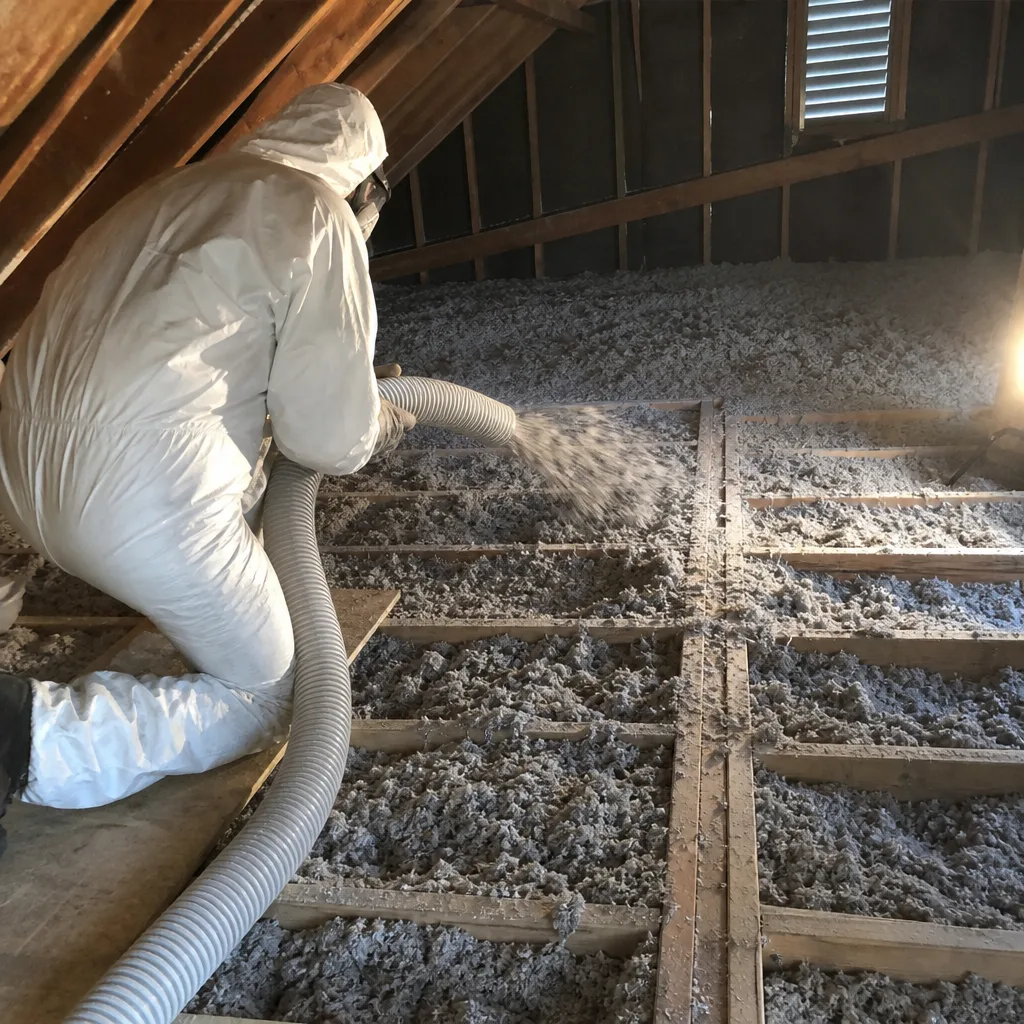
The sequence matters. Blowing insulation over an unsealed attic floor is a documented waste of material – warm, conditioned air finds every gap in a top plate or can-light collar and escapes regardless of how thick the blanket above it is. We don’t skip step one.
-
Pre-Job Attic Assessment and Written Scope
Before any price is named, a technician from Topside Attic Insulation Buena Park walks the attic with a flashlight, a moisture meter, and a tape measure. We note the existing R-value, identify any moisture or pest damage that needs to be addressed first, document accessible air leakage points (top plates, can-light penetrations, dropped soffits, plumbing and electrical chases), and measure the square footage. You receive a written scope and a flat price – Haven Standard Clause 1. No work starts without your signature on that document.
-
Air Sealing the Attic Floor
This step is completed before any insulation is touched. Technicians seal the top plates where interior walls meet the attic floor, collar every recessed can light that isn’t rated for insulation contact, foam-seal electrical and plumbing penetrations, and close any gaps around dropped-ceiling soffits. In Buena Park homes with original 1960s and 1970s construction – common in the area around Knott Avenue and Orangethorpe – the number of unsealed top-plate penetrations we find routinely surprises homeowners who assumed their attic was already tight. On applicable jobs, we take a blower-door reading before sealing so you have a documented baseline.
-
Depth Markers and Ventilation Protection
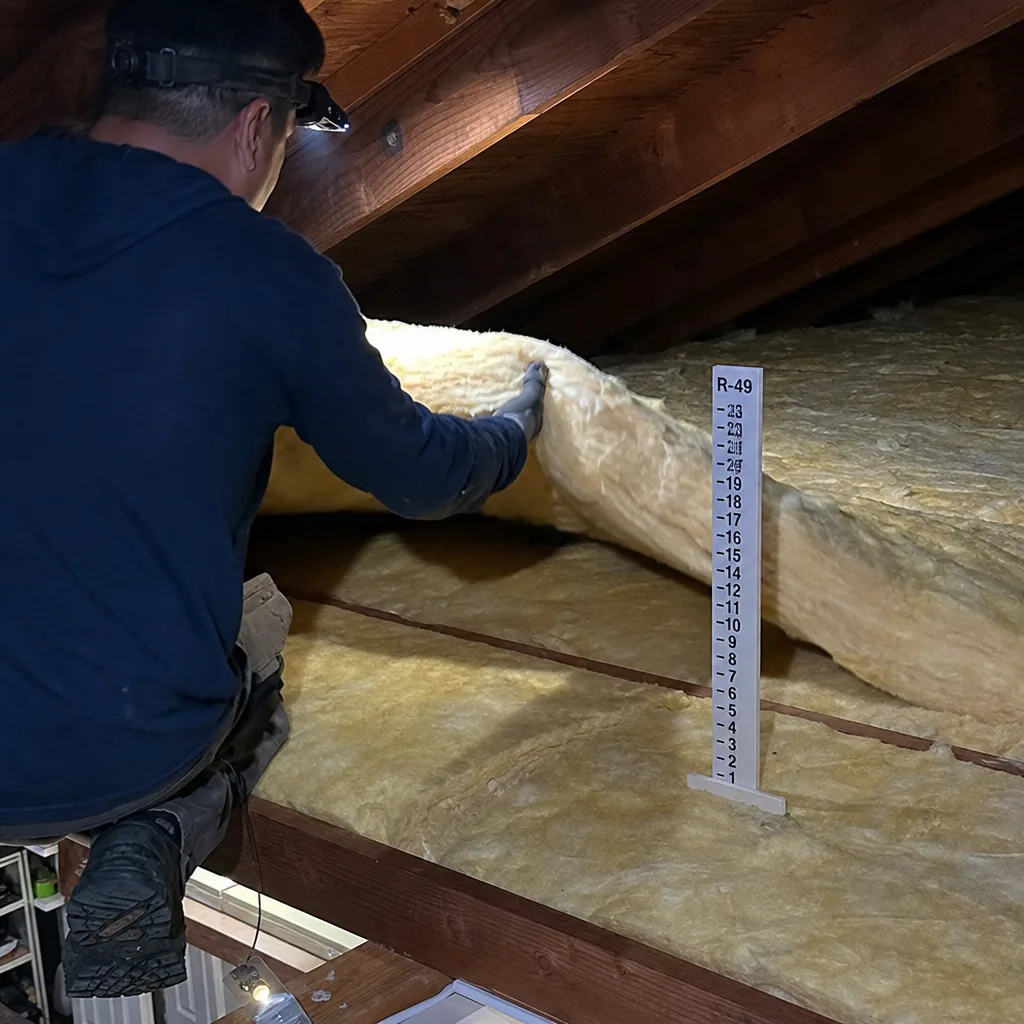
Before the blower starts, we install depth-indicator stakes across the attic floor spaced to meet California Energy Commission installation standards. These stay visible in the insulation so that any future inspector – or you – can confirm depth at a glance. We also baffle every soffit vent to keep the insulation from blocking the ventilation channel that runs from the eaves to the ridge. Blocking soffit vents is one of the most common installation errors we see when we’re called in to evaluate work done by other contractors in Buena Park and the surrounding cities.
-
Blown-In Installation
The insulation machine runs from outside the home; the hose feeds through the attic access. Depending on what the assessment found and what the customer prefers, we install GreenFiber cellulose or CertainTeed fiberglass blown-in material to the depth specified in the written scope – typically enough to reach R-38 to R-49 for most Buena Park attics, or higher if the homeowner is targeting a tighter building envelope. Both products perform well in Southern California’s climate; cellulose has a slightly higher recycled content and tends to be the call for attics where existing insulation was removed due to contamination. Fiberglass is the call when moisture history makes us cautious about a product that can hold water if a future roof leak goes undetected.
-
Post-Installation Blower-Door Test and Documentation
On applicable jobs, we run a second blower-door reading after air sealing is complete and document the before and after numbers on your job record. A reading that started at 3,800 CFM50 dropping to 1,900 CFM50 tells you more than any marketing claim we could make. Every job closes with a Documented Photo Record – photos of the air sealing work, the depth stakes in place, and the finished insulation surface – so you have a visual record of what was done and where.
-
Cleanup and 365-Day Done Right Review
The crew walks out the attic the same way they walked in – no debris, no insulation tracked through the home. Before leaving, the technician reviews the written warranty with you. Under the 365-Day Done Right Promise, if anything about this job isn’t right within the first year, we make it right. That commitment is in the paperwork you already signed before we started.
Blown-In Attic Insulation Pricing in Buena Park
Blown-in attic insulation in Buena Park runs between $1,400 and $3,200 for most residential jobs. For a detailed breakdown, see How Much Does Attic Insulation Cost? (2026 Price Guide) - Buena Park, CA. The range is wide because the variables are real – here’s what actually moves the number:
| Factor | Lower End Impact | Higher End Impact |
|---|---|---|
| Attic square footage | Under 800 sq ft | Over 1,800 sq ft |
| Target R-value | R-38 (code minimum) | R-49 to R-60 (high-performance) |
| Air sealing scope | Few penetrations, modern construction | Pre-1980 home with many unsealed top plates and can lights |
| Existing insulation removal needed | None required | Full attic cleanout required before installation |
| Access difficulty | Standard pull-down stair access | Low-pitch attic, tight access, or split attic levels |
| Material selected | Cellulose (GreenFiber) | Premium fiberglass blown-in (CertainTeed) |
Air sealing is included in the project scope – not itemized as a separate upsell – because blowing insulation over an unsealed floor produces a result we won’t stand behind. The written price you receive before any work starts includes both the sealing and the insulation so there are no line-item surprises on the back end.
If you’ve received a competing estimate, bring it. Under Haven Standard, we offer a Free Second Opinion on any written estimate – Wes Okafor or a senior technician will read it with you and tell you plainly what’s in it, what isn’t, and what questions to ask the other contractor before you sign anything. Call (562) 418-5767 to set that up, or to get your own written estimate scheduled.
Key Takeaways on Cost
- Most Buena Park single-story homes (1,000-1,400 sq ft attic) fall between $1,600 and $2,400 all-in, including air sealing.
- Homes in older Buena Park neighborhoods where can lights and open top plates are common will trend toward the higher end of the air-sealing scope, adding $200-$500 to the base insulation cost.
- The written price is flat – no change orders for material overages or labor that runs long, unless the scope changes after you and the technician agree on a documented scope change.
- California’s TECH Clean California program and local utility rebates through SCE and SoCalGas may offset a portion of the cost; ask about current availability when you schedule.
FAQs – Blown-In Attic Insulation in Buena Park
How long does a blown-in attic insulation job take in Buena Park?
Most blown-in attic insulation jobs in Buena Park are completed in four to eight hours, start to finish, including air sealing. A 1,200 square-foot attic with moderate air-sealing scope typically runs about half a day for a two-person crew. Homes with extensive penetrations, contaminated insulation that needs removal first, or very limited attic access may require a second day – which would be documented in the written scope before any work starts, not discovered partway through the job.
What R-value does Buena Park require for attic insulation?
Buena Park falls within California Climate Zone 8, where Title 24 sets R-38 as the minimum for attic insulation in new construction and most permitted retrofit work. That translates to roughly 10-12 inches of blown-in fiberglass or about 13-14 inches of cellulose. Many homeowners in Buena Park who purchased homes built in the 1970s and 1980s find existing insulation that’s settled to a depth equivalent to R-11 or R-13 – less than a third of what current code calls for. We install to the depth specified in the written scope, and the depth stakes left in the attic confirm it after we leave.
Is blown-in insulation better than batts for an attic?
For most existing Buena Park attics, blown-in is the better option. Batts require clean, uniform joist spacing to install without gaps, and most attics have enough obstructions – HVAC equipment, ductwork, irregular framing, existing wiring – that batts leave voids. Blown-in material conforms around those obstacles and covers the full attic floor with a consistent depth. The one situation where Attic Batt Insulation makes more sense is a new-construction attic with perfectly uniform framing and nothing in the way yet. In 9,000-plus homes sealed and insulated since 2016, the attic floor scenario that genuinely favors batts is rare in Southern California’s existing housing stock.
Do I need to leave the house during blown-in insulation installation?
You don’t need to leave, but most homeowners find it easier to be out for a few hours during the blowing phase. The machine runs outside and the hose feeds through the attic access, so there’s minimal disruption to living areas. Fiberglass blown-in material produces fine particles that can migrate through an open attic access hatch, so we seal the hatch perimeter before starting and keep it sealed during installation. If anyone in the household has respiratory sensitivities, being out of the home during the blowing phase and for a couple of hours after is a reasonable precaution. Your technician will walk you through the specifics at the start of the job – under Haven Standard: Arrive on schedule, you’ll have a named technician and a text when they’re on the way, so you can plan accordingly.
Why Buena Park Homeowners Choose Topside Attic Insulation
Buena Park’s housing stock skews heavily toward post-war and mid-century single-family homes – a lot of 1,100 to 1,600 square-foot ranches and split-levels built between 1955 and 1985, concentrated in neighborhoods like Whitaker Estates, the Bellehurst area near Beach Boulevard, and the streets east of Dale Street toward Cypress. These homes share a common insulation problem: the original fiberglass batts were installed to the standards of their era, which were well below what Southern California Energy Code requires today. Many have also had can-light retrofits done over the decades that left penetrations into the attic completely open – a situation that makes any insulation upgrade partially ineffective until those penetrations are closed.
We’ve also seen a specific pattern in Buena Park attics that sit above homes with original roof configurations: radiant heat loading through the roof deck combines with inadequate insulation depth to push attic temperatures past 140 degrees Fahrenheit on summer afternoons. At that temperature, the air conditioning system works against a significant thermal load regardless of how well the equipment itself performs. A properly installed blown-in insulation layer – following complete air sealing of the attic floor – reduces that load to something the existing HVAC can manage without running constantly.
Our parent home page covers the full scope of building-envelope services we provide, if you’re evaluating work beyond the attic.
Wes Okafor has been running jobs in Buena Park and the surrounding cities since 2016. The Haven Standard he built the business around isn’t a tagline – it’s the job record you hold in your hand when we leave: written price, written warranty, documented photo record, and blower-door numbers before and after. That record exists because homeowners who research contractors carefully deserve to know exactly what they paid for.
Call (562) 418-5767 to schedule a free attic assessment and get a written estimate for your Buena Park home. A live person answers – no voicemail, no callback window. If you have a competing estimate already, bring it along and we’ll go through it with you before you decide anything.
Written by Wes Okafor, Owner at Topside Attic Insulation Buena Park, serving Buena Park.